Greek Wedding Traditions, from the Morning to the Last Dance
A Greek wedding is two things at once. There is the Orthodox sacrament in the church, with an order of service that has barely changed in centuries. Around it there is a looser web of family customs: some ancient, some recent, and some that vary from one village to the next. If you are marrying in Greece, or marrying into a Greek family, it helps to know which is which.
This guide follows a typical wedding day in order. For each moment you will find what it is, when it happens, what guests do, and a short note on how it looks from behind the camera. Where a custom depends on the region or the family, we say so. Where something is more of a film cliché than a living tradition, we say that too.
Two kinds of tradition
The sacrament. If you have a church wedding, the service is the Orthodox rite of marriage. Its parts (the rings, the crowns, the common cup, the procession around the table) are set by the Church, and the priest leads them.
The customs. Making the bed, shaving the groom, the sugared almonds, the dancing: these belong to families and places, not to the Church. Each family keeps a different selection, and some of these customs are fading, particularly in the cities.
Neither kind is compulsory for a civil or a symbolic wedding. Many couples keep the customs they love and skip the rest.
Before the wedding day
Making the bed (to krevati)
In the days before the wedding, often one or two evenings before, women from both families gather at the couple’s new home to make up the marriage bed. The bed is covered with rice, petals, sugared almonds and money, and in many families a baby is rolled across it as a wish for children. In some versions the bed is made by unmarried women, and there is a game around who will marry next. It is usually lively, loud and full of laughter.
Practice differs a great deal. Sources describe different nights, different people and different details, and the custom has fallen out of fashion in many larger cities. If the bed matters to your family, ask the oldest women in it how they do it. Their version is the right one for your wedding.
Behind the camera The bed is an indoor event, often at night, so it needs to be planned into the coverage. It is not something to improvise on the day. The pictures that last are of the hands, the petals and the coins, and of the grandmothers’ faces.
Choosing the date
The Church does not celebrate weddings in certain periods of the year. These usually include Lent and Holy Week, the first half of August and the days before Christmas, along with a few individual feast days. The exact calendar varies from one Metropolis to another. Check with the parish before you book anything else.
The morning
Getting ready, in two houses
Traditionally the bride and groom get ready separately, each with their own family and friends, and they meet at the church. The groom usually leaves a little earlier, so that he is there before the bride arrives.
Shaving the groom
At the groom’s house, his koumbaros (more on that role below) gives him a ceremonial shave, often with friends around him who help with the shirt, the cufflinks and the jacket. It is usually described as a sign of trust between the two men. For many grooms today it is a few symbolic strokes rather than a full shave.
Behind the camera It is a short, close-up moment that can happen quickly, so tell your photographer whether you plan to do it and at roughly what time.
Small superstitions at the bride’s house
Some families keep small rituals at the bride’s house. The names of her single friends are written on the soles of her shoes, and the names that have worn away by the end of the night are said to be the next to marry. A cube of sugar is tucked into her glove or dress for a sweet life. As she leaves, she looks back at her parents’ house. None of these is universal. They are worth knowing about mainly so that nobody is caught by surprise.
At the church
Arriving and waiting
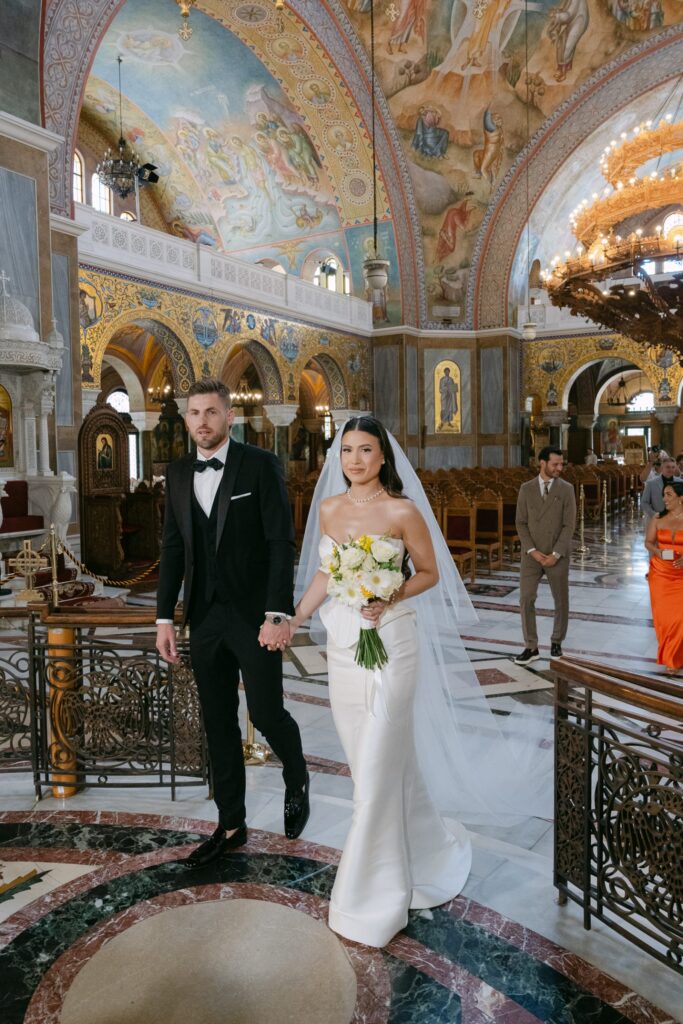
Guests gather outside the church before the ceremony and go in with the couple or just after them. The groom usually waits for the bride at the church entrance, holding her bouquet. Her father walks her to the door, where the groom gives her the flowers and takes her right hand from her father, and the two of them walk down the aisle together, with their families and guests following.
Behind the camera The moment at the door lasts only a few seconds and happens once, so let your photographer know roughly when the bride’s car will arrive.
Small favours (bonbonnières) with sugared almonds may be handed out at the church or later at the reception.
A practical point for couples from abroad: in the Church of Greece, weddings are normally held in the parish church. A ceremony in a small chapel needs the local Metropolitan’s permission, and private chapels on estates or at hotels are generally not allowed. That rule covers most of Greece but not Crete or the Dodecanese, which are under different church jurisdictions. If you have a picturesque chapel in mind, ask about it before you fall in love with it.
The ceremony, in brief
The Orthodox service has no vows. The couple make their commitment through actions and symbols, in two parts:
- The betrothal. The priest blesses the rings, and they are placed on the ring finger of the right hand, where Orthodox Christians wear them. The koumbaros or koumbara then swaps them between the couple three times.
- The crowning. Each of the couple is given a lit candle. The priest joins their right hands, which stay joined until the end. Then come the stefana, two crowns linked by a ribbon. The priest crowns the couple, and the koumbaros swaps the crowns three times above their heads.
- The readings. The readings are from Paul’s letter to the Ephesians and the Gospel of the wedding at Cana.
- The common cup. After the Lord’s Prayer the couple sip wine from one cup, a sign that they will share everything in life.
- The Dance of Isaiah. Holding the Gospel book, the priest leads the couple three times around the table while hymns are sung. The first of them begins “O Isaiah, dance for joy”, which gives the procession its name.
- The removal of the crowns. The priest lifts off the crowns with a final blessing.
Many couples keep their stefana at home afterwards. We have written a separate, step-by-step guide to the service, with notes on where we stand in the church: The Greek Orthodox Wedding Ceremony, Explained.

The foot step
During the Epistle, at the line where the wife is told to “fear” (in other words, respect) her husband, many brides step lightly on the groom’s foot, and sometimes the groom tries to step first. Guests usually laugh. This is a folk joke, not part of the rite. If you want to do it, it is polite to mention it to the priest beforehand.
The koumbaros and koumbara
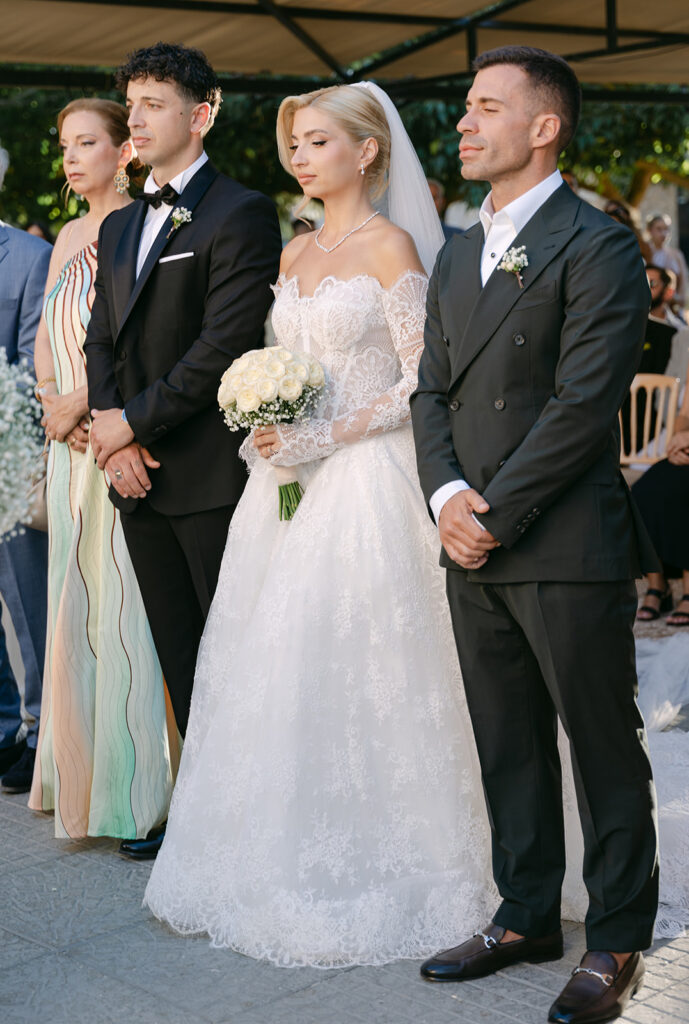
The koumbaros (or koumbara for a woman) is more than a best man. He or she is the sponsor of the marriage and takes part in the sacrament itself by exchanging the rings and the crowns. Because of that, the sponsor must be an Orthodox Christian in good standing. Friends who are not Orthodox can still stand with you as part of the wedding party, but they cannot exchange the rings or crowns. Traditionally the relationship lasts beyond the wedding, and some families ask the koumbaros to be godparent to the couple’s first child as well. This is a family custom, not a Church rule.
If one of you is not Orthodox
The Church of Greece allows an Orthodox Christian to marry a Christian of another church, such as a Roman Catholic or a Protestant, provided that he or she was baptised in the name of the Holy Trinity. The non-Orthodox partner provides a baptism certificate and a declaration that the couple’s children will be baptised and raised Orthodox. If there is also a ceremony in the other partner’s church, the Orthodox wedding must be the later of the two. The Church does not marry an Orthodox Christian to a non-Christian unless that partner is baptised.
Other options: a civil wedding at the town hall is legally equal to a church wedding in Greece. Since February 2024, civil marriage is also open to same-sex couples. For documents, deadlines and the symbolic-ceremony route, see Getting Married in Greece and, for Patras specifically, Civil Wedding in Patras and Marriage licence in Patras.
Leaving the church
Wishes, almonds and rice
After the ceremony the couple usually stand at the front of the church, often with their parents and the koumbaros, and guests come up one by one to congratulate them. The phrases you will hear most are Na zisete! (“May you live long”, said to the couple) and Na sas zisoun! (said to the parents). Single guests may hear Kala stefana!, “good crowns”, meaning “may your turn come”. More of them in our guide to Greek wedding wishes.
As the couple leave, guests throw rice, and sometimes petals or sugared almonds. Many churches only allow this outside, so check first.
Behind the camera The line of wishes is long and full of hugs, and it is where family photographs are often hardest to find time for. If group photos matter to you, agree a short list in advance.
Koufeta
Sugared almonds, koufeta, are the classic Greek wedding favour, usually wrapped in tulle or a small box. Tradition calls for an odd number (five or seven are common), because an odd number cannot be divided evenly, just as the couple should not be divided. There is one more superstition: an unmarried woman who sleeps with a wedding almond under her pillow will dream of the man she will marry.
The reception
The first dances
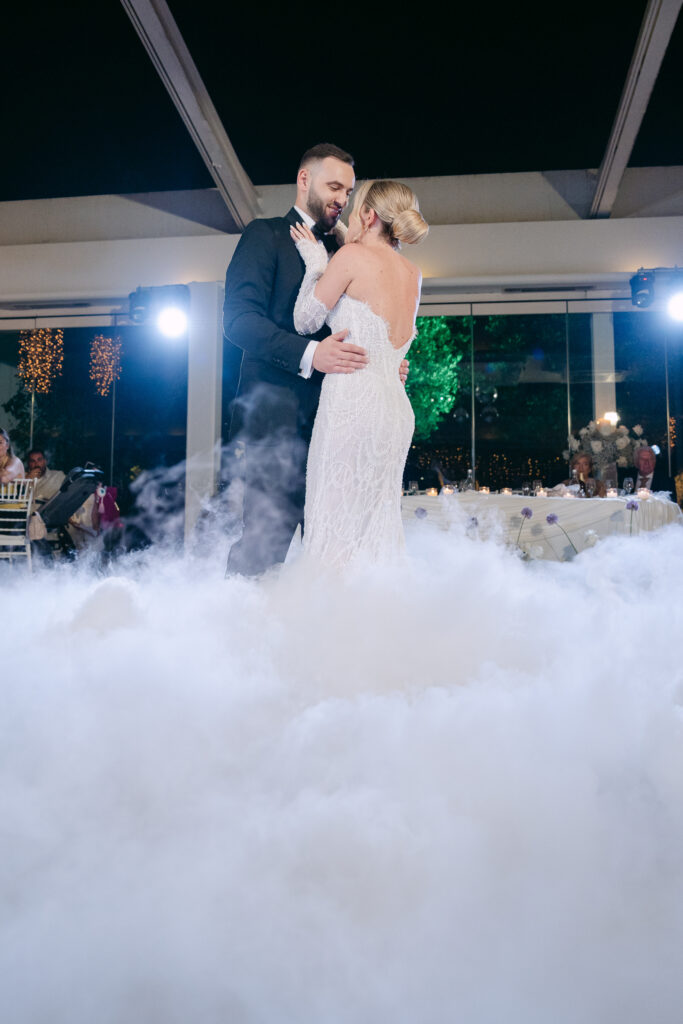
A Greek reception usually opens with the couple dancing, followed by their parents, the koumbaros and close family, often in a traditional circle or line dance. Then the floor opens to everyone. The music and the dances themselves vary a lot by region, and many couples now begin with a modern first dance and move to Greek dances afterwards.
Behind the camera The opening dances are some of the most emotional frames of the evening, because three generations are on the floor at once. Tell your photographer the order of the dances, so nobody important is missed.
The money dance
In some regions, guests pin or tuck banknotes onto the couple’s clothes while they dance. It is more often seen at Greek weddings abroad than at weddings in Greece today. If it is part of your family’s tradition, it is lovely. If not, nobody will expect it.
Plate smashing
Smashing plates is the image many people outside Greece connect with a Greek celebration. In fact it belongs more to the bouzouki nightclubs of the 1960s and 70s than to the village wedding. It was banned in tavernas in 1969, and it is rarer today. Where it still happens, plaster plates or thrown flowers are often used instead. Most venues will not expect it. If you want it, ask the venue first.
What this means for your day
You do not need to keep every custom. You do not need to know them all either. The families who know their traditions will bring them to the wedding, and the rest of the day can be yours. Our advice is simple: ask your parents and grandparents which customs mattered at their own weddings, tell the priest about anything you plan in the church, and give your photographer a short list of the moments you care about. For the shape of the whole day, see our wedding day timeline.
Questions couples ask
Do couples say vows at a Greek Orthodox wedding?
No. The Orthodox service has no spoken vows. The commitment is expressed through the rings, the crowns, the common cup and the procession around the table.
What are stefana?
Stefana are the two wedding crowns, joined by a ribbon, that are placed on the couple’s heads during the service. The koumbaros swaps them three times. Many couples keep them at home afterwards.
Does the koumbaros have to be Orthodox?
Yes. The sponsor who exchanges the rings and crowns must be an Orthodox Christian in good standing. Non-Orthodox friends can be part of the wedding party, but they don’t exchange the rings or crowns.
Can we have an Orthodox wedding if only one of us is Orthodox?
Yes, if the other partner is a Christian baptised in the name of the Holy Trinity. They provide a baptism certificate, and you both agree that your children will be baptised Orthodox. Your local Metropolis issues the licence, so ask the parish early.
Why are there an odd number of sugared almonds?
Tradition says an odd number can’t be divided evenly, just as the couple shouldn’t be.
Is plate smashing part of a Greek wedding?
Not usually today. It grew up in nightclubs and tavernas, was banned in tavernas in 1969, and is now rarer, often with plaster plates or flowers instead. Check with your venue if you want it.
Planning a wedding in Greece?
Tell us your date, your church or venue and where you are travelling from. Our studio is in Patras, Greece, and we have been photographing weddings since 2013 (4.9 on Google · 200+ reviews). You can see complete wedding days in our wedding stories.
Ask about your date