Insights · Marriage licence
Before the flowers, the music and the dress, there's one piece of paper that won't wait: the marriage licence. Without it, neither the priest nor the mayor can marry you.
This guide explains who issues the licence for a church wedding and who issues it for a civil one, which documents are usually requested, how long the licence is valid and what to do after the wedding. The information comes from official sources, listed at the end. Some details vary from one Metropolis to the next and from one municipality to the next, so at each step we point out what to double-check.
Contents (7)
What the marriage licence is
It's the approval every couple needs before the wedding. It confirms that there is no impediment: that neither of you is already married, that no family relationship prevents the marriage, and that the wedding has been announced in a newspaper.
A church wedding and a civil wedding have the same legal standing in Greece, but the licence comes from a different authority. For a church wedding it is issued by the Holy Metropolis (the local diocese of the Orthodox Church), through your parish. For a civil wedding, by the mayor of the municipality where you live.
Licence for a church wedding: step by step
1. Start with your parish
Your first stop is the priest of your parish. He tells you which papers you need and fills in the forms with you. When everything is ready, the file goes to the marriage office of the Holy Metropolis, which issues the licence. In Patras, this is the Holy Metropolis of Patras. Ask your priest or the Metropolis office about the procedure and opening hours.
2. The documents usually requested
The list is not the same everywhere. As an example, these are the documents named in the published guidance of two Metropolises (Thessaloniki, and Monemvasia and Sparta):
- An ID card or another official document for each of you.
- A certificate of single status, drawn up with the priest, with two adult witnesses and solemn declarations.
- A recent certificate of family status (the Metropolis of Thessaloniki asks for one issued within the last month).
- A baptism certificate.
- The whole newspaper issue with the wedding announcement.
- A stamp duty or fee, where the Metropolis asks for one.
- If there was a previous marriage: the document showing it was dissolved, or the death certificate, as applicable.
If one of you is not Orthodox, if you have already had a civil wedding, or if any document was issued abroad, extra papers are needed (for foreign documents, usually an Apostille and a translation). Tell the priest at your first meeting.
3. The newspaper announcement
The wedding is announced in a newspaper before the licence is issued. Keep the whole issue. The timing rules vary: the Metropolis of Thessaloniki, for example, asks that the announcement be no older than three months and published at least 15 days before the wedding. Ask what applies in your own Metropolis before you publish.
If you have already had a civil wedding and are now having a church wedding with the same person, the Metropolis of Thessaloniki states that no new announcement is needed: the civil marriage certificate is submitted instead.
4. How long the licence is valid
A church marriage licence is valid for a limited time. In the Metropolis of Thessaloniki the wedding must take place within three months, otherwise the licence has to be renewed. So don't get it too early: ask how long it is valid and count back from your wedding date.
5. If the wedding is in another parish or another town
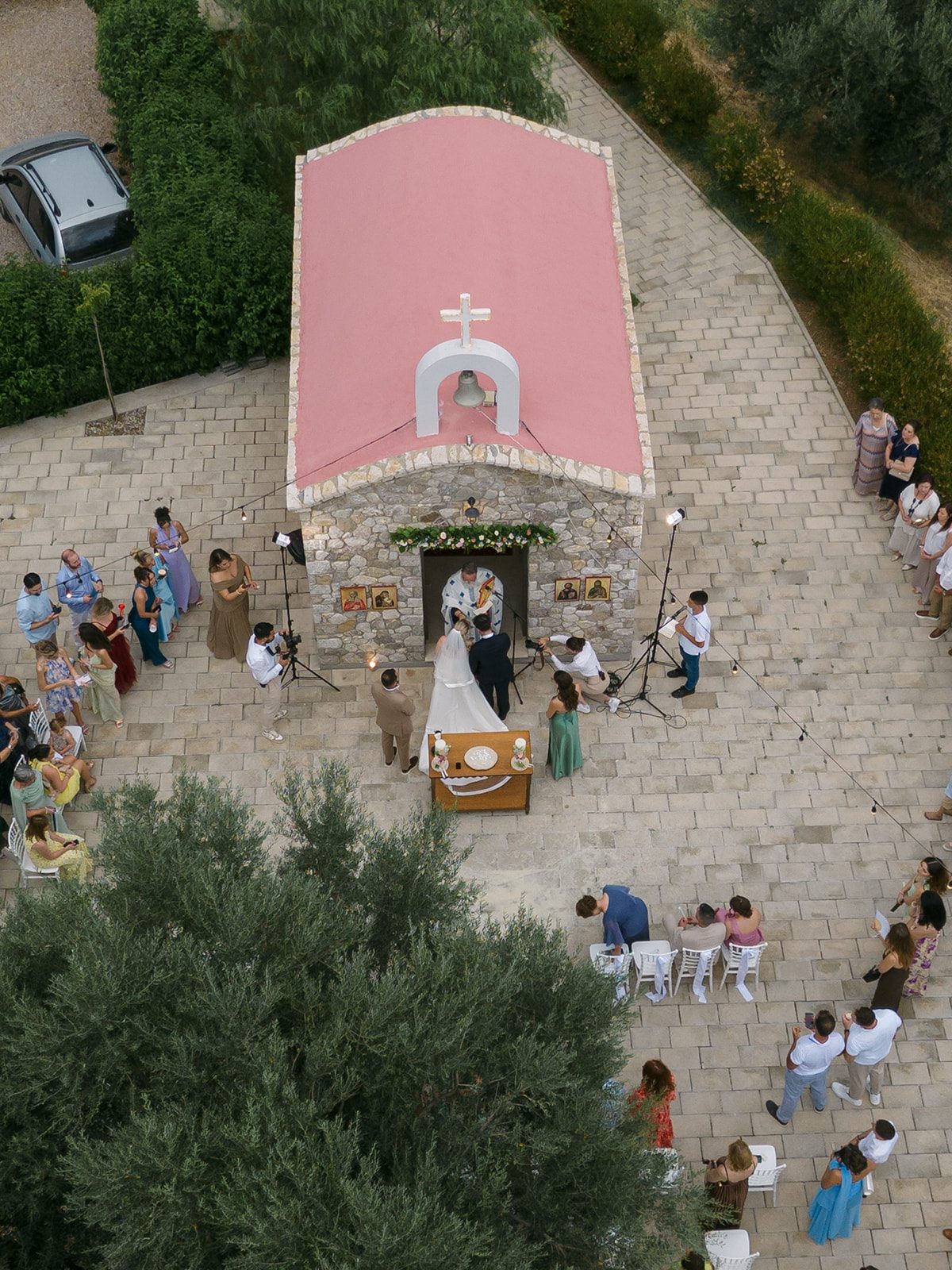
Many couples live in Patras and marry in a chapel in Achaia, or live in Athens and marry in their home town. The licence has to reach the priest of the church where the ceremony will take place. Ask from the start which Metropolis issues the licence and how it will be delivered, so nothing is left for the last week. For churches in our area, see our guide to wedding churches in Patras and Achaia.
Licence for a civil wedding
For a civil wedding, the licence is issued by the mayor of the municipality where you live. According to the Greek National Register of Administrative Procedures:
- You apply online through gov.gr, or at the municipality.
- Documents include, among others, a copy of your ID, a birth certificate, proof of residence, a solemn declaration and the newspaper issue with the announcement.
- The licence is issued free of charge.
- It is issued within seven days and is valid for six months.
- If the wedding does not take place within six months of the announcement, the announcement must be repeated.
You'll find the whole process, including the ceremony at the Municipality of Patras, in our guide to a civil wedding in Patras.
Church or civil: how the licence differs
| Church wedding | Civil wedding | |
|---|---|---|
| Issued by | The Holy Metropolis, through the parish | The mayor of your place of residence |
| Where you start | With your parish priest | On gov.gr or at the municipality |
| Newspaper announcement | Yes (with exceptions, e.g. after a civil wedding) | Yes |
| Valid for | Set by the Metropolis (e.g. three months in Thessaloniki) | Six months |
After the wedding: registering the marriage
The licence is not the last piece of paper. After the ceremony, the marriage is registered at the civil registry of the municipality where it took place. Don't leave it until after the honeymoon: according to guidance from the Greek Ministry of Foreign Affairs, a church marriage registered after 40 days counts as late and needs a fee. Ask the priest which documents he will give you for the registration.
Once it is registered, you can get the marriage certificate online from gov.gr, free of charge.
A timeline for the paperwork
- As soon as you book the church and the date: ask the parish which documents the Metropolis requires and how long the licence is valid.
- A few weeks before: certificates, solemn declarations, witnesses and the newspaper announcement, within the time limits you were given.
- Once it is issued: the licence goes to the priest of the church where you will marry.
- After the wedding: registration at the civil registry and the marriage certificate from gov.gr.
For everything else, from the church to the reception, see our wedding planning checklist.
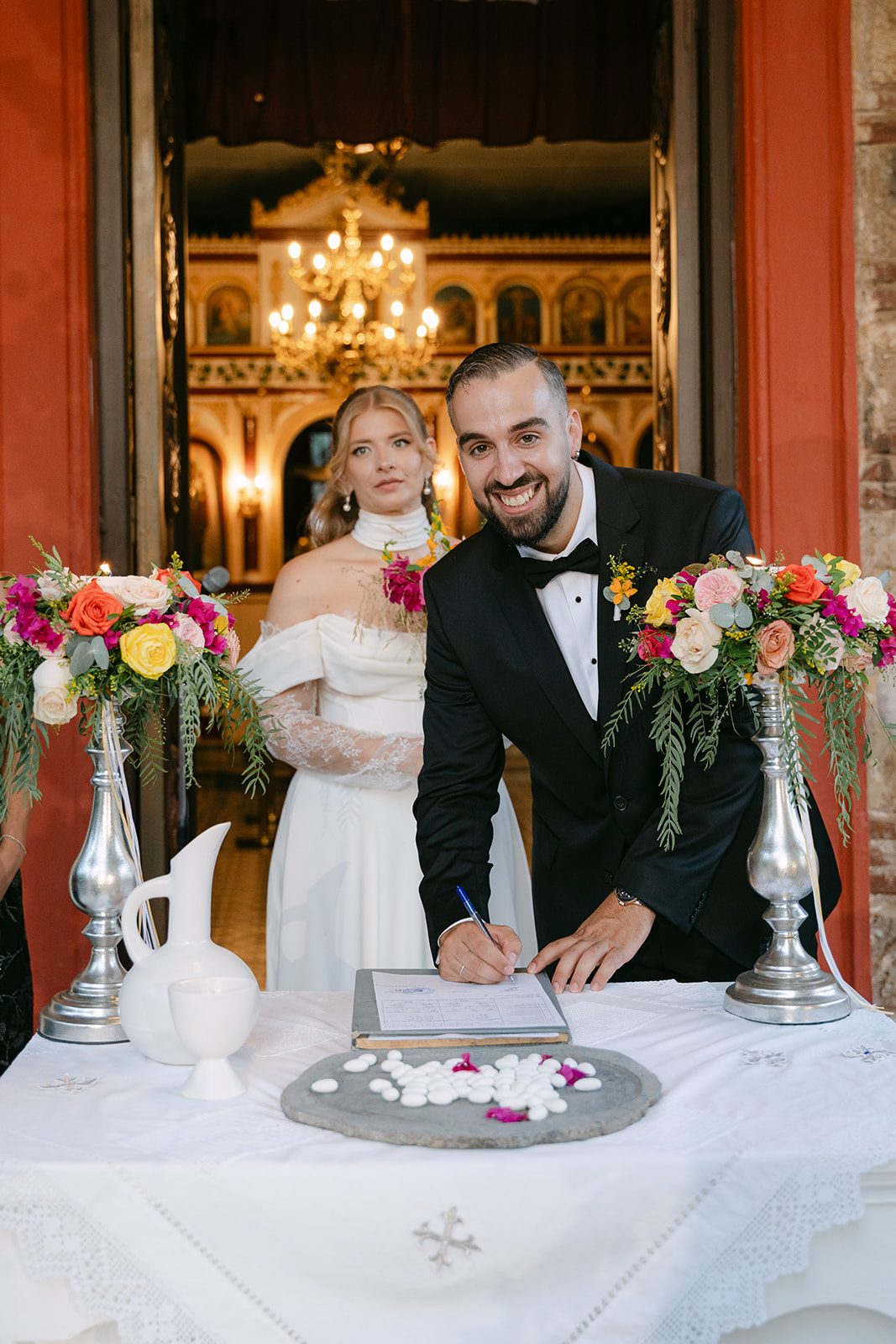
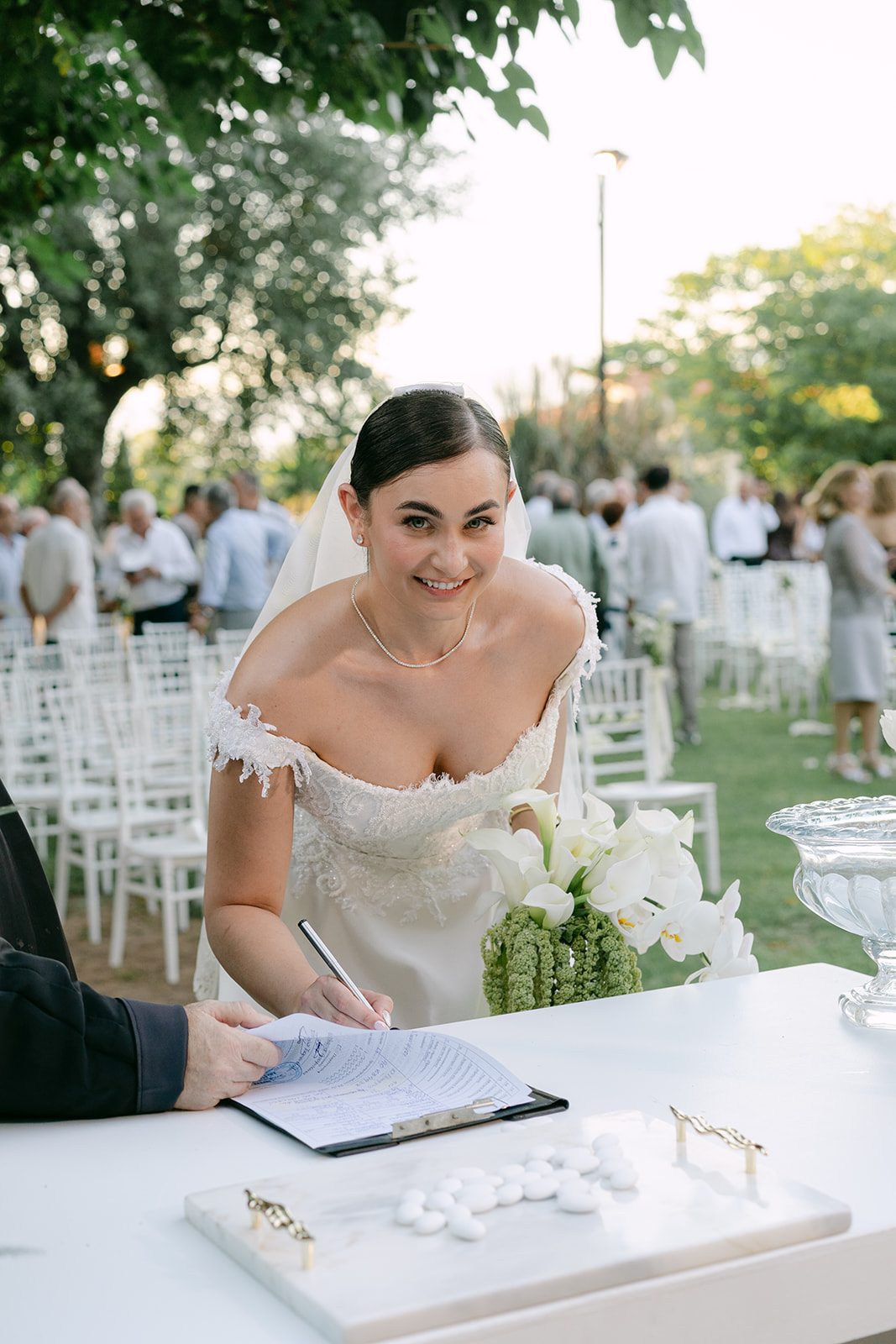
Paperwork doesn't make it into the album. The signature does: it's the last small moment of the ceremony, before the congratulations and the rice.
Sources (checked 26 October 2026, in Greek): National Register of Administrative Procedures: civil marriage licence · Holy Metropolis of Thessaloniki: marriage licence · Holy Metropolis of Monemvasia and Sparta: wedding guidance · National Register of Administrative Procedures: marriage certificate · Ministry of Foreign Affairs: marriage registration. Procedures can change; always confirm with your parish, Metropolis or municipality.
Frequently asked questions about the marriage licence
Where do we get a church marriage licence in Patras?
From the Holy Metropolis of Patras, through your parish. You start with the parish priest, who tells you the documents and prepares the file.
How long is a marriage licence valid?
A civil marriage licence is valid for six months. The validity of a church licence is set by the Metropolis; in Thessaloniki, for example, it is three months. Ask your parish.
Is a newspaper announcement still required?
Yes, for both a church and a civil wedding. Keep the whole newspaper issue.
Can we apply for the marriage licence online?
For a civil wedding, yes: you apply through gov.gr. For a church wedding the process goes through the parish and the Metropolis; ask your priest what can be done online.
How much does a marriage licence cost?
A civil marriage licence is issued free of charge. For a church wedding, some Metropolises ask for a stamp duty or fee; your parish will tell you the amount.
Do you have a date?
Once the paperwork is done, the best part is still to come. Tell us when and where you're getting married, and we'll send you a proposal for the photography and film of your day.
Photographs: Dimitris Stergiou and the studio team